Most plumbing problems feel urgent when they start. Only a few of them are emergencies. This guide is written for houses in and around Alma, where every home has its own well, pressure tank and septic system. It explains what to do in the first few minutes, how to tell what can wait until morning, and how to find and test your shut-off valve while things are calm.
The first thing to do when a pipe bursts
If water is spraying or pouring, stop the supply first and work out the rest later. In an Alma house the water does not come from a street main. It comes from your well, through a pump, into a pressure tank, and from there to the rest of the house. So the steps are a little different from the advice you will find online for houses on town water.
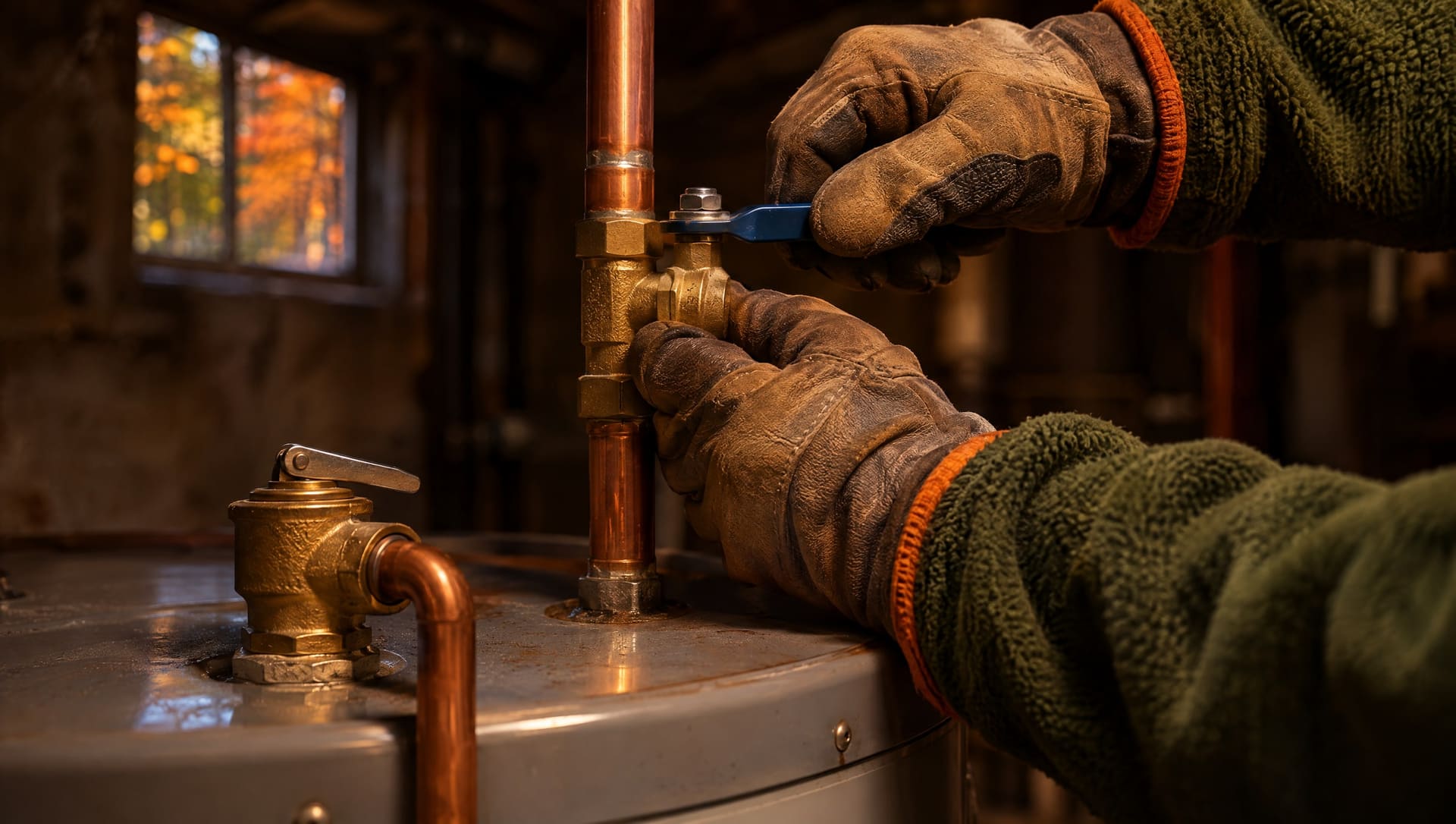
- Shut the main valve beside the pressure tank. It is usually on the pipe leaving the tank, before the line splits off to the water heater and the rest of the house. Turn it clockwise until it stops, or a quarter turn if it has a lever handle.
- Turn off the well pump at its breaker in the electrical panel. With the valve closed this is not strictly needed, but it stops the pump cycling if the leak is between the tank and the valve, and it keeps a damaged system from running the pump dry.
- Open the lowest cold tap in the house, often a laundry tub or a basement tap, to drain the water still under pressure in the pipes and the tank.
- If water is near a light fixture, an outlet or the electrical panel, do not walk through it. Turn off the breaker for that area only if you can reach the panel from a dry spot. If you cannot, stay clear and say so when you call.
- If the water heater is electric, switch its breaker off once the water is shut off, so the elements do not run in a tank that may be draining.
- Move what you can off the floor, put down towels and take photos of the damage for your insurer.
With the water off, the house is safe to wait in, and the leak itself will not get any worse.
What counts as a plumbing emergency
A plumbing emergency is water or waste that you cannot stop, or a problem that will cause real damage or a safety risk if it waits until the next working day. In practice that means:
- A burst or split pipe, or a leak you cannot stop at a fixture valve.
- Water reaching wiring, the electrical panel or a ceiling below.
- Sewage coming back up through a floor drain, tub or toilet. On a septic-fed house this usually means a blockage in the line to the tank or a tank that is full. Stop using water in the house so nothing more goes down the drains, and call.
- No water at all in deep cold. In a January cold snap this can be a frozen line in a crawl space, an outside wall or an unheated well pit, or a well pump that has stopped. Either way, it is worth calling.
- A smell of gas near a gas water heater. Leave the house first, then call your gas supplier from outside. That one is a gas call before it is a plumbing call.
Many problems that feel like emergencies can wait for a regular appointment. A dripping tap, a toilet that runs, a single slow drain, or a small leak under a sink that a bucket can catch and that stops when you close the valve under the fixture are all worth fixing soon, but not in the middle of the night. If you are not sure, describe what the water is doing when you call and ask. A plumber can usually tell you over the phone whether it can wait.
Why pipes burst in Alma houses
Cold is the usual cause. Environment Canada's 1981 to 2010 climate normals for the Fergus Shand Dam station, the nearest to Alma, give a January mean daily temperature of −7.4 °C, a mean daily minimum of −11.1 °C and a record low of −35 °C. That is cold enough to freeze water standing in a crawl space, in a pipe run along an outside wall, or in the line between the well and the house where it passes through an unheated well pit. Water expands as it freezes, and the pipe splits. Often the split only shows itself once the line thaws and water starts to move again.
The age of the house matters too. The oldest houses near Peel Street West, Church Street and Simpson Street date from the 1850s to the 1890s. They were built before indoor plumbing and later fitted with galvanized steel water lines, which corrode from the inside and can give way at a threaded joint. Houses from the 1930s to the 1950s along Wellington Road 7 and Wellington Road 17 often have galvanized pipe or early copper, and early copper can develop pinhole leaks. A pinhole leak is rarely dramatic, but it means the same pipe will probably leak again elsewhere. Once the emergency is over, ask about plumbing repairs for the pipe around it.
Who to call when a water pipe bursts
Shut off the water first, then call a plumber. A plumber who works on well-and-septic houses will ask where the water came from, whether the valve at the pressure tank stopped it, whether the well pump is off and whether water has reached anything electrical. Have those answers ready, plus where the leak is and roughly how long it ran.
Call your home insurer once the water is off and you have photos. Ask whether they want to send an adjuster before any drywall or flooring is removed.
If water has soaked an electrical panel or fixtures, an electrician may need to check them before the power goes back on in that part of the house.
When the plumber arrives, they will look at the break, the pipe on either side of it and the cause. If a frozen line will freeze again in the same place next winter, a new section of pipe is not enough, so expect them to look at insulation, heat and the route of the line. Work is performed by licensed plumbers (306A Certificate of Qualification). You should get a written price before the repair starts, so you know the cost in general terms before any part is fitted.
How to find and test your main shut-off valve
Find your shut-off on a quiet afternoon, before there is ever water on the floor. Late autumn, before the first hard freeze, is a good time to do it.
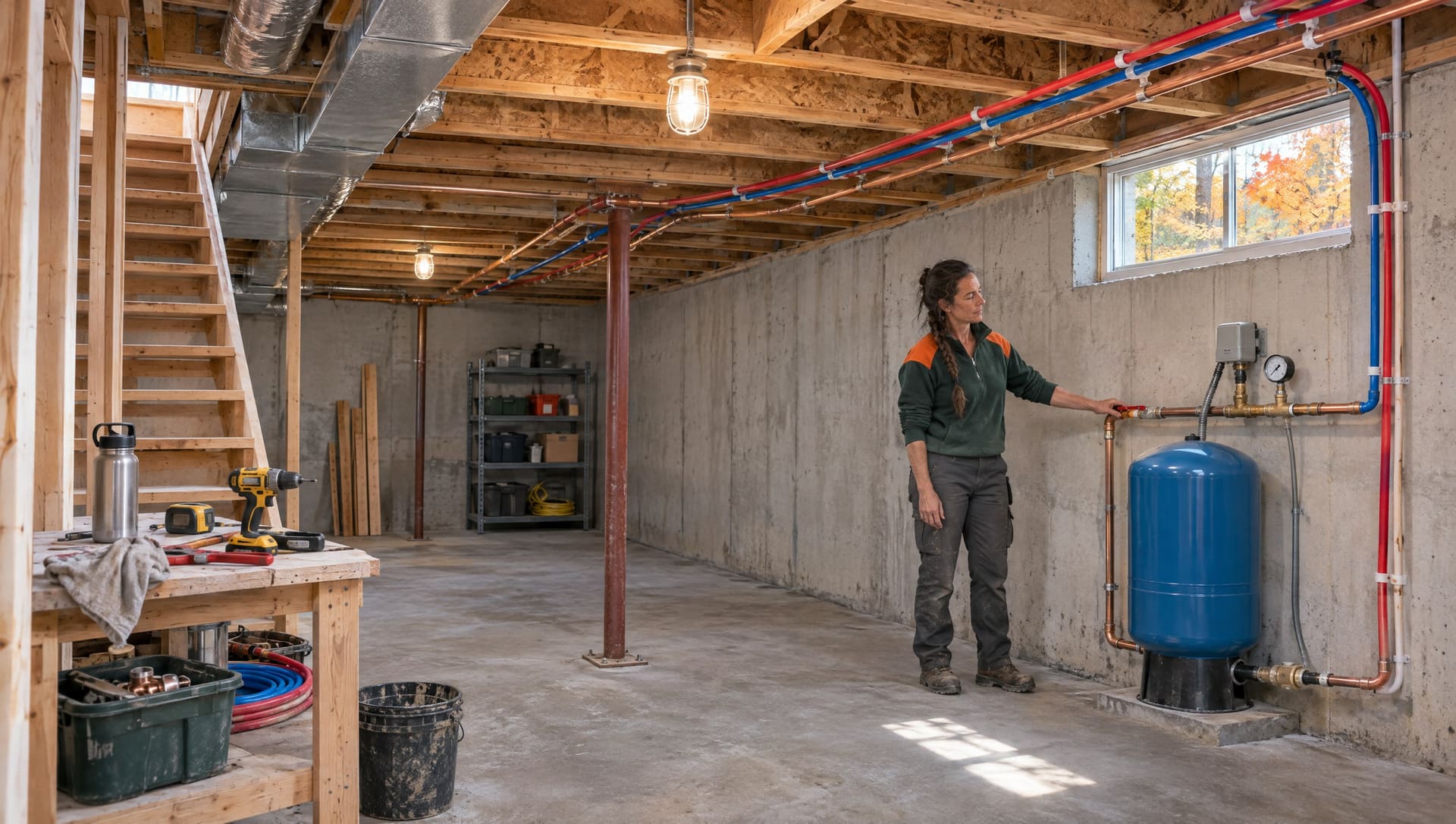
Start at the pressure tank. It is the large rounded tank, usually in the basement or utility room, with a pressure switch and gauge nearby. Follow the pipe that comes in from the well to the tank, then the pipe that leaves the tank for the house. The main shut-off is normally on that outgoing line, close to the tank. Some houses also have a valve on the incoming line from the well. It helps to know both.
To test it:
- Close the valve fully. A lever handle needs a quarter turn so it sits across the pipe. A round wheel handle turns clockwise until it stops.
- Open a cold tap upstairs. The flow should slow to a trickle and stop within a minute as the pipes empty.
- If water keeps running steadily, the valve is not sealing.
- Open the valve again slowly and check the stem for drips.
Older houses often have a round-handled gate valve that has not been turned in years. If it will not move with firm hand pressure, do not force it with a wrench. An old valve can snap at the stem or start leaking where it did not before. Leave it open and have a plumber replace it with a lever-type valve. It is a small job, and it makes the next emergency much easier to handle.
While you are there, label the valve and the well pump breaker, and show everyone in the house where they are. If you have a well pit outside, check that its cover is in place before winter.
If a pipe has burst or water is somewhere it should not be, our emergency plumber page explains how to reach Alma Plumber and what happens next.