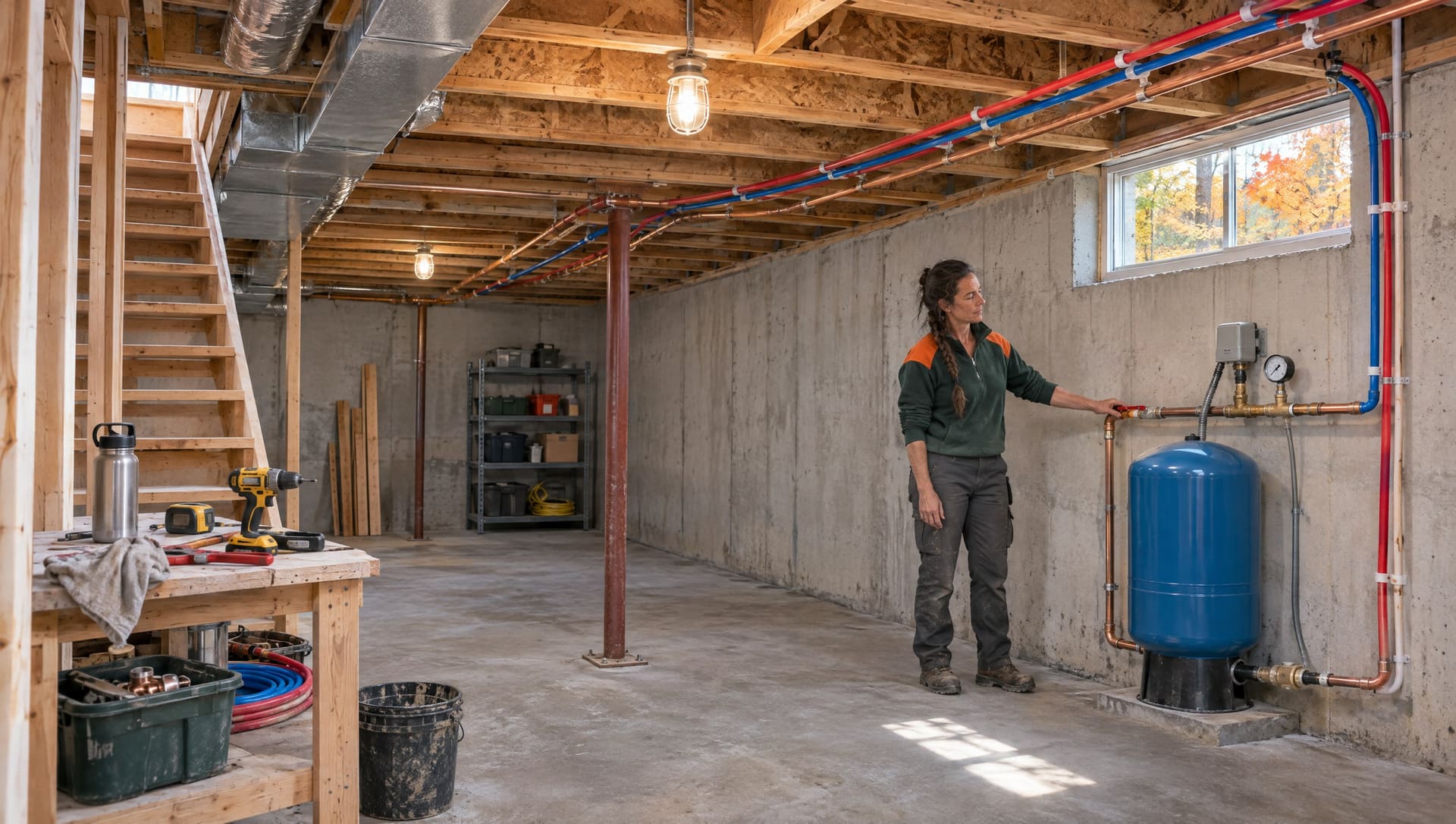
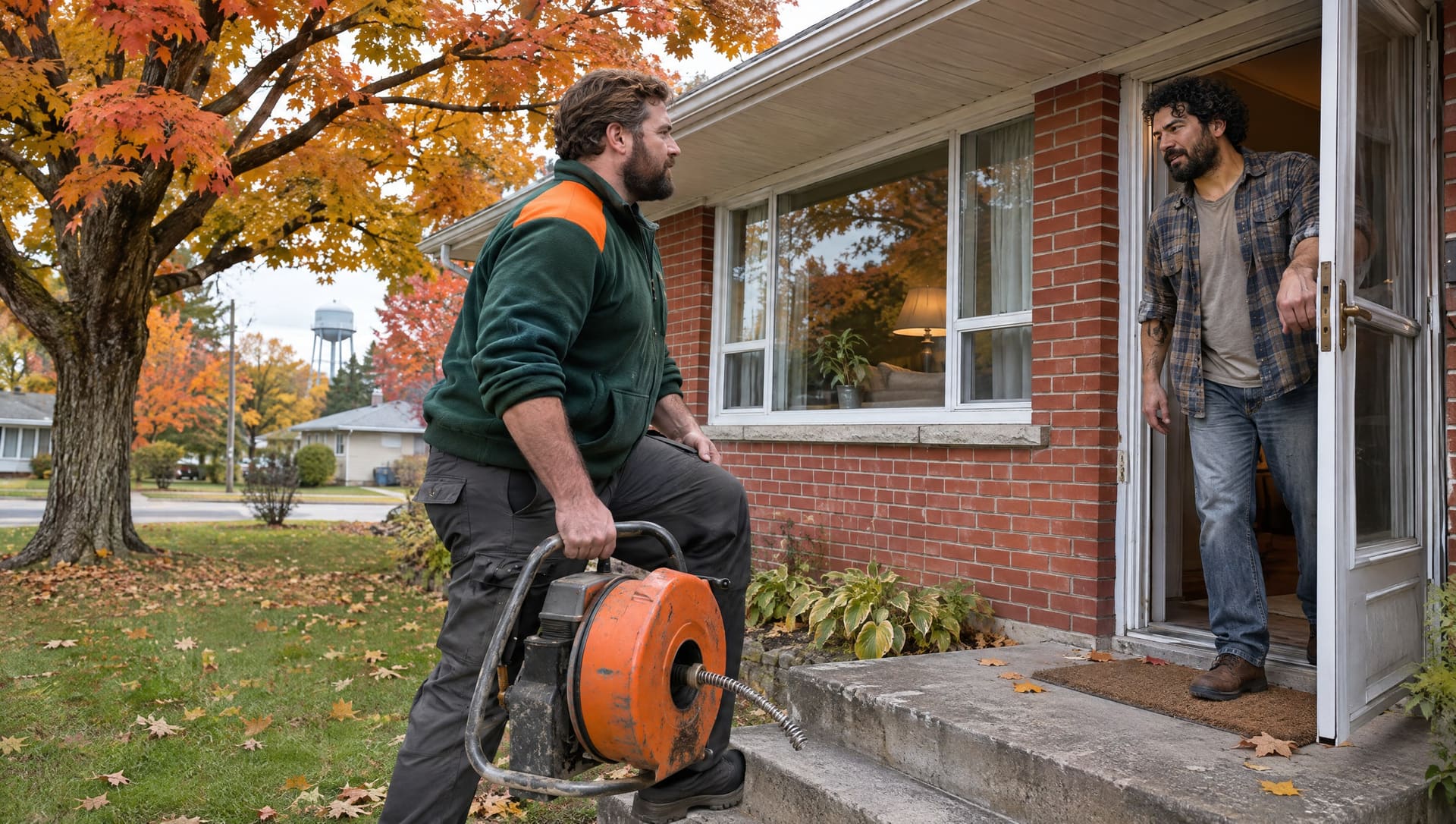
In Alma, every drain in the house ends at a septic tank on your own lot. That changes a few things about clearing a blockage: what you put down the line, how much water you run, and how a plumber decides on the right tool.
Ease up on water before anything else
If a sink, tub or toilet is draining slowly, the safest first step is to use less water for a while. Hold off on laundry, the dishwasher and long showers. Everything that goes down a drain has to go somewhere. If the blockage sits between the house and the septic tank, the water you run piles up behind it and comes out of the lowest opening it can find, often a basement floor drain or a downstairs shower.
Then count how many fixtures are affected.
- One slow sink or tub is usually a local blockage in that fixture's trap or branch line. You can often deal with it yourself.
- Several slow fixtures at once, a toilet that gurgles when the washer empties, or water rising in the basement floor drain point further down: the main drain, the pipe out to the tank, or the tank itself. Stop running water and call rather than keep working at it.
If waste water is already on the floor, see what counts as a plumbing emergency.
What "drainage cleaning" means in a septic house
Drainage cleaning means clearing the pipes that carry waste water away: the traps under each fixture, the branch lines in the walls and floors, the main stack, and the building drain that runs out to the septic tank.
It is not the same as pumping the septic tank. Pumping removes the solids that settle in the tank, and it is done by a septic pumping contractor. People often mix the two up. Snaking a drain will not help a tank that is full, and pumping the tank will not clear grease stuck in the kitchen branch line. A good part of a plumber's job on a septic house is working out which one you are dealing with.
Some people also use the phrase for foundation drains, the weeping tile around a basement that carries groundwater to a sump. That is a separate system. If it is the one giving trouble, see sump pumps.
Quick fixes you can safely try
For a single slow fixture, these are reasonable things to try:
- Plunge it. Use a cup plunger on sinks and tubs, and a flanged plunger on toilets. On a double sink or a sink with an overflow hole, block the other opening with a wet cloth so the pressure goes down the drain.
- Clean the sink trap. Put a bucket underneath, loosen the two slip nuts by hand and empty the U-shaped trap. A lot of kitchen and bathroom blockages are right there.
- Pull the hair out of a tub drain. Lift out the stopper and use a plastic drain strip or a bent piece of wire.
- Use a small hand auger. A closet auger is made for toilets and will not scratch the porcelain.
- Run hot tap water to loosen soap and light grease. Do not use boiling water, because it can soften plastic drain joints.
Do not use harsh chemical drain products in a septic house. Whatever goes down the drain ends up in the tank, where bacteria do the work of breaking down waste. Stop after two honest tries. Stop as well if more than one fixture is involved or you smell sewage.
How a plumber finds the blockage
A plumber starts by asking which fixtures are slow, since when, and when the septic tank was last pumped. Then they look for a cleanout. That is a capped fitting at the base of the stack or where the drain leaves the foundation, which gives straight access to the main line. Older houses may have few cleanouts, or ones buried behind finished walls, so access sometimes takes longer than the clearing itself.
If the tank lid can be reached, the plumber may check the level at the inlet. If water is standing high in the tank, the problem is the tank or the leaching bed, not the house drain. You should be told that plainly so you can call for pumping rather than pay for snaking that will not help. A leaching bed that is soaked by spring melt or heavy rain can make the whole house drain slowly without any clog in the pipe at all.
Winter brings one more possibility. Environment Canada's 1981 to 2010 normals for Fergus Shand Dam, the station near Alma, give a January mean daily minimum of −11.1 °C. That is cold enough to freeze lines in crawl spaces and outside walls. A drain running through one of those spaces can hold ice, and ice has to be thawed rather than cut.
Snaking or water jetting: which one clears what
A drain snake (also called a cable or auger) is a coiled steel cable that spins as it is fed into the pipe, with a head chosen for the job. A water jet is a hose with a nozzle that sprays water at high pressure, mostly backward, scouring the pipe walls as it moves.
A snake is usually the better choice for:
- hair, soap and wipes caught in a branch line
- a solid object or a toilet blockage
- roots growing in through the joints of a clay pipe, using a cutting head
A water jet is usually the better choice for:
- grease built up along the walls of a kitchen line
- sludge and silt lying along the bottom of a long main drain
- scale inside cast iron, and fine roots left behind after cutting
A snake opens a passage through the blockage but may leave material stuck to the pipe walls. A jet cleans the full width of the pipe. On a septic house, jetting needs some judgment. The water goes into your tank, so a careful plumber keeps the volume reasonable and holds off if the tank is already near its limit. Old clay with shifted joints, or cast iron that has rusted thin, may not stand up to full pressure. A camera look first tells the plumber whether to turn the pressure down or use a cable instead.
What the age of your house tells the plumber
The oldest streets around Peel Street West, Church Street and Simpson Street were built from the 1850s to the 1890s, before indoor plumbing. The drains added later are typically cast iron and clay running to a septic tank. Roots find the clay joints, and cast iron scales and rusts from the inside. These lines are usually cut with a cable first and then checked with a camera.
Houses from the 1930s to the 1950s along Wellington Road 7 and Wellington Road 17 typically have cast-iron stacks with clay tile running to an older septic tank, plus a basement floor drain. That floor drain is often the first place a main-line blockage shows up. Cast iron of that age can rust through on its underside, which a camera will show.
Newer houses with ABS or PVC drains have smooth pipe that rarely scales. Blockages there usually come from what went down the drain, and gentle jetting tends to clear them well.
When cleaning is not enough
Sometimes clearing the line is the whole job. Sometimes it only buys time. Signs the pipe itself needs attention:
- the same line blocks again within a few months
- the cable brings back roots, clay fragments or rust flakes
- the camera shows a cracked, sagging or collapsed section
Then the choice is between clearing the line on a schedule and replacing the damaged section. Clearing is generally the smaller job. Replacement means opening a floor or digging, so it costs more. Replacing or altering a drain generally needs a building permit, and the municipal building department will say whether your job does. You should see a written price for each option before deciding. More detail is on the sewer repair page.
Habits that keep septic drains clear
- Pour cooking grease into a can, not the sink.
- Flush only toilet paper. Wipes sold as flushable still snag in old pipe and do not break down in the tank.
- Put strainers in tub and shower drains.
- Spread laundry loads across the week so the tank and bed are not flooded in one day.
- Have the tank pumped on the schedule your septic professional recommends.
If a drain in your house is slow or backing up, the drain cleaning page explains how Alma Plumber clears lines that run to a septic tank.